

Table of Contents
ToggleMVP Development Process in 2026: How Successful Startups Actually Build Products
A lot of founders think MVP development starts with coding.
It usually doesn’t.
The best startup products rarely begin with developers opening VS Code and immediately building features.
They begin with uncertainty.
A founder notices a problem.
A workflow feels broken.
An industry still relies on spreadsheets.
A repetitive task keeps wasting time.
An AI use case suddenly becomes possible.
That’s usually how startup ideas begin.
But here’s where things get interesting:
most startup ideas sound good in the beginning.
Very few survive real users.
That’s why the MVP development process matters so much now.
Especially in 2026 where:
- SaaS markets move faster
- AI products launch daily
- users expect polished experiences immediately
- startup competition is brutal
Founders don’t really win anymore just because they had an idea first.
They win because they validate faster.
Learn faster.
Improve faster.
And that entire cycle depends on how well the MVP development process is handled from day one.
The problem is that many founders still approach MVP development emotionally instead of strategically.
They overbuild.
Overcomplicate.
Add too many features.
Hire too quickly.
Scale prematurely.
Then six months later they realize:
users didn’t even care about half the product.
That happens constantly.
A strong MVP development process prevents that mistake.
It helps startups:
- reduce risk
- validate demand
- launch faster
- save money
- improve product-market fit
- build scalable software foundations
without wasting years building the wrong thing.
And honestly, modern startup founders need that discipline more than ever now.
The Biggest Misunderstanding About MVP Development
A lot of people still think MVP means:
“build the cheapest version possible.”
That’s not really true.
A proper MVP is not:
- low quality
- broken
- rushed
- ugly
- incomplete
A strong MVP simply focuses on solving one important problem clearly without unnecessary complexity.
That distinction matters.
Because there’s a massive difference between:
- lean and
- careless
Good MVP development feels focused.
Not unfinished.
The MVP Development Process Starts Before Development
This is where many startups go wrong immediately.
They start building before validating.
That’s dangerous.
Because software development is expensive.
Time-consuming.
Mentally exhausting.
And building the wrong product faster still produces the wrong outcome.
That’s why the MVP development process usually begins with:
- validation
- research
- customer understanding
- market analysis
before development even starts.
Step 1: Validate the Problem Before Building Anything
This stage matters more than most founders realize.
And honestly?
A lot of startups rush through it because validation feels slower than coding.
But skipping validation is usually where expensive mistakes begin.
The goal here is simple:
prove the problem actually matters.
Not just to you.
To real users.
Strong startup validation usually includes:
- customer interviews
- competitor research
- surveys
- waitlists
- landing pages
- beta signups
The smartest founders spend time understanding:
- what users hate
- where workflows break
- what tools frustrate people
- where inefficiencies exist
- what people already pay for
Because if users don’t deeply care about the problem, the product becomes difficult to grow later.
No amount of marketing fixes weak demand.
Step 2: Define the Core MVP Scope
This is where founders usually start losing focus.
Every feature begins feeling important.
Everything sounds valuable.
That’s dangerous.
A proper MVP development process requires ruthless prioritization.
The startup needs to identify:
- the core problem
- the primary workflow
- the essential functionality
without adding unnecessary complexity.
A useful question founders should constantly ask:
“If we removed this feature, would the product still solve the main problem?”
If the answer is yes, it probably doesn’t belong in version one.
This is where experienced MVP development companies help startups significantly.
Because outside perspective prevents feature overload.
Most Startups Overbuild Their First Product
This happens constantly in startup ecosystems.
Founders assume:
more features = more value.
Usually the opposite happens.
More features often create:
- confusion
- slower onboarding
- higher development costs
- longer timelines
- more bugs
- weaker UX
The best startup products often feel incredibly simple initially.
That simplicity is intentional.
Step 3: Plan the User Experience Properly
A lot of founders underestimate UX during MVP development.
That’s a mistake.
Modern users expect software to feel intuitive immediately.
Especially now that AI-native tools are raising expectations around usability and speed.
The MVP development process should heavily focus on:
- onboarding clarity
- friction reduction
- workflow simplicity
- navigation logic
- user flow optimization
Because early retention depends heavily on usability.
If users feel confused within the first few minutes, most will never return.
That’s just reality now.
Step 4: Choose the Right Technology Stack
This stage creates unnecessary anxiety for many founders.
People obsess over:
- frameworks
- databases
- programming languages
- infrastructure decisions
before even validating the product properly.
The truth is:
the best tech stack is usually the one that helps startups move efficiently without creating scalability problems later.
Modern SaaS MVP development commonly uses:
- React
- Next.js
- Node.js
- Python
- PostgreSQL
- Firebase
- Supabase
- AWS
AI startups increasingly rely on Python because of machine learning ecosystems and LLM integrations.
But founders should avoid overengineering early.
An MVP does not need:
- enterprise infrastructure
- massive microservices
- overcomplicated architecture
The goal is validation first.
Not building systems for imaginary millions of users on day one.
Step 5: Start Development Lean
Now development finally begins.
And this is where startup discipline matters most.
The strongest MVP development companies focus heavily on:
- lean execution
- scalable architecture
- rapid iteration
- clean workflows
- maintainable systems
instead of trying to impress founders with unnecessary complexity.
The development phase usually includes:
- frontend systems
- backend development
- APIs
- authentication
- payment integrations
- admin panels
- core workflows
- database architecture
But again:
the best MVP development process stays focused.
The startup is trying to validate.
Not build the final enterprise platform immediately.
AI Is Changing the MVP Development Process Fast
This shift is happening everywhere now.
Developers increasingly use AI tools for:
- coding assistance
- debugging
- testing
- automation
- documentation
- workflow acceleration
This helps startups move dramatically faster.
But there’s something important founders should understand:
AI accelerates execution.
It does not replace product strategy.
Strong startup products still require:
- architecture thinking
- UX decisions
- scalability planning
- product prioritization
- human judgment
That layer still matters massively.
Step 6: Testing Is More Important Than Founders Think
A lot of founders rush launches too quickly.
Bad idea.
Users forgive missing features.
They rarely forgive broken experiences.
Before launch, startups should test:
- onboarding flows
- responsiveness
- authentication
- mobile usability
- payment systems
- dashboards
- workflows
- API behavior
Because unstable MVPs damage trust immediately.
And first impressions are hard to recover from.
Step 7: Launch Before You Feel Fully Ready
This part feels uncomfortable for most founders.
That’s normal.
But the MVP development process is built around learning through real usage.
Not endless internal planning.
The smartest startups launch earlier than they feel comfortable with because:
real users reveal truth faster than assumptions.
Modern startup launches often happen through:
- beta access
- waitlists
- niche communities
- founder audiences
- Product Hunt
- LinkedIn audiences
The goal isn’t perfection.
The goal is feedback.
The Real Work Starts After Launch
This is where many founders misunderstand startup development completely.
Launch is not the finish line.
It’s the beginning of product intelligence.
Now the startup can finally analyze:
- retention
- onboarding friction
- feature usage
- churn
- customer feedback
- activation rates
And this is where the MVP development process becomes incredibly powerful.
Because instead of building based on assumptions, startups begin improving based on actual user behavior.
That changes everything.
Most Startup Success Comes From Iteration
Rarely from version one.
The best startup founders constantly refine:
- onboarding
- pricing
- workflows
- positioning
- retention systems
- product simplicity
based on real-world usage.
That iteration cycle is what eventually creates product-market fit.
Not giant feature lists.
Common MVP Development Mistakes Founders Still Make
Even in 2026, the same mistakes keep appearing.
Building Too Many Features
Probably the biggest one.
Founders overload products before users even validate the core experience.
Skipping Validation
Many startups build products nobody actually asked for.
That’s incredibly risky.
Hiring Based Only on Price
Cheap development often creates:
- technical debt
- rebuilding costs
- scalability issues
- weak UX
- unstable systems
Low upfront cost sometimes becomes extremely expensive later.
Ignoring Scalability Completely
An MVP should stay lean.
But it still needs thoughtful architecture underneath.
That balance matters.
Why Startups Work With MVP Development Companies
Many founders eventually realize:
building startup software is more than coding.
It involves:
- product strategy
- prioritization
- UX
- scalability planning
- iteration systems
- launch strategy
That’s why startup-focused MVP development companies exist.
The best ones help founders:
- move faster
- avoid technical waste
- reduce risk
- build scalable products
- launch intelligently
instead of simply writing code.
Why Growable Digital Focuses on Startup MVP Development
Growable Digital works differently than traditional software agencies because the focus stays heavily aligned with startup realities.
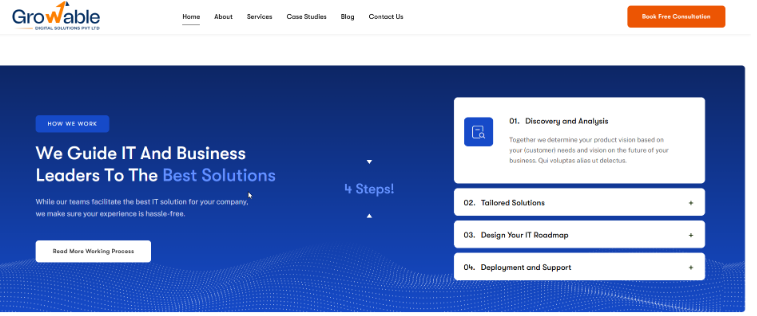
That means:
- lean development
- scalable architecture
- AI-ready infrastructure
- fast iteration
- startup-focused product strategy
instead of bloated enterprise-style development cycles.
Whether founders are building:
- SaaS products
- AI platforms
- startup marketplaces
- automation systems
- custom software products
Growable Digital helps startups move from idea to scalable product without unnecessary complexity slowing them down.
If you want a deeper breakdown of MVP strategy, startup validation, SaaS development, scalability planning, and custom product growth, explore Growable Digital’s complete guide:
MVP Development Company: Complete Startup Guide to Building an MVP in 2026
FAQs About the MVP Development Process
What is the MVP development process?
The MVP development process involves validating an idea, defining core features, designing workflows, developing lean functionality, testing the product, launching early, and improving based on user feedback.
How do startups build MVPs successfully?
Successful startups focus on solving one important problem clearly instead of overbuilding large feature-heavy products initially.
How long does MVP development take?
Most MVPs take between 4 weeks and 6 months depending on complexity, integrations, AI features, and product scope.
What comes first in MVP development?
Validation should always come before development. Startups need to prove user demand before investing heavily into software development.
How much does MVP development cost?
MVP costs vary widely depending on complexity, but most startup MVPs range between $10,000 and $100,000+.
Why do startups fail during MVP development?
Common reasons include:
- feature overload
- poor validation
- weak UX
- bad scalability planning
- hiring inexperienced developers
Should startups hire MVP development companies?
Many startups work with MVP development companies because they provide strategy, UX, scalability planning, development, testing, and launch support together.
What is SaaS MVP development?
SaaS MVP development focuses on building lean subscription-based software products for validation and early market testing.
How important is UX during MVP development?
Very important. Strong onboarding and usability heavily impact retention and product adoption.
Can AI speed up MVP development?
Yes. AI tools can accelerate coding, testing, automation, and workflows significantly, but product strategy and architecture still require experienced human thinking.