

Table of Contents
ToggleHow to Choose the Right SaaS based Product Development Company in 2026
Introduction
A lot of founders think building a SaaS product is mostly about writing code. It’s not.
Code is only one part of the problem. The harder part is building the right product before you run out of time, money, or motivation. That’s where most SaaS startups struggle.
Someone gets excited about an idea, hires a few developers, spends six months building features, launches the product, and then realizes users don’t really care. Not because the idea was terrible. Usually because the product was built without enough validation, clarity, or product thinking behind it. That’s why choosing the right SaaS product development company matters much more than people think.
A good SaaS partner doesn’t just “develop software.”
They help founders avoid expensive mistakes.
They help simplify the roadmap.
They push back when features don’t make sense.
They think about scalability early.
They help founders launch faster instead of disappearing into endless development cycles.
And in 2026, speed matters more than ever.
The SaaS market is crowded now. AI tools are making product launches faster. Users expect better UX. Investors want traction earlier. Founders can’t afford to waste 12 months building bloated software nobody asked for.
The teams winning right now are building lean. They validate quickly. They launch MVPs early. They improve based on real usage. And they work with development partners who actually understand SaaS businesses, not just software development. This guide breaks down how modern SaaS development really works, what founders should expect, what mistakes to avoid, and how to choose the right SaaS product development company in 2026.
What is a SaaS based Product Development Company?
Most people hear “software company” and assume every development team works the same way.
They don’t.
There’s a huge difference between building a normal app and building a SaaS business.
A regular software company might build websites, mobile apps, internal dashboards, or one-time software projects.
A SaaS product development company focuses specifically on subscription-based software products.
That means they understand things like the following:
- User onboarding
- Subscription billing
- Product scalability
- Multi-user systems
- Cloud infrastructure
- Security
- Retention
- Analytics
- Recurring revenue models
- Product-led growth
Those details matter because SaaS products behave differently after launch.
You’re not shipping a project and walking away.
You’re building a system people use every day.
That changes how the product needs to be designed from the beginning.
For example, if you’re building a CRM platform, you’re not only creating dashboards.
You also need:
- Team permissions
- Billing systems
- Notifications
- API integrations
- Usage tracking
- Subscription management
- Data security
- Performance optimization
- Scalable backend architecture
That’s why founders often struggle when they hire generic app developers for SaaS products.
The product works at first.
Then growth starts breaking everything.
Slow dashboards.
Messy architecture.
Security issues.
Database problems.
Features are taking forever to ship.
Technical debt everywhere.
A real SaaS development agency plans for growth early even if the first version is lean.
That balance is important.
Because overengineering kills startups too.
The goal isn’t building enterprise software on day one.
The goal is building a smart MVP that can grow properly later.
That’s what experienced SaaS product development services actually help with.
Why SaaS Businesses Are Growing So Fast in 2026
Founders love SaaS because it solves one of the biggest business problems: unpredictability.
Traditional service businesses constantly start from zero every month.
SaaS works differently.
If customers stay, revenue compounds.
That changes everything.
Hiring becomes easier.
Forecasting becomes easier.
Growth becomes easier to measure.
And investors pay attention faster.
But recurring revenue is only one reason SaaS keeps growing.
SaaS Can Scale Without Scaling Chaos
This is probably the biggest reason founders choose SaaS.
A service agency grows by adding more people.
A SaaS product grows by improving systems.
That’s a completely different business model.
You can onboard users in different countries without opening physical offices.
You can automate support.
You can automate onboarding.
You can automate reporting.
Good SaaS products keep getting more efficient as they grow.
That’s why SaaS companies often become extremely profitable after finding product-market fit.
AI Changed the SaaS Market Completely
A few years ago, most SaaS tools were basically dashboards.
Now users expect automation.
They expect AI summaries.
AI workflows.
AI recommendations.
AI-generated outputs.
Even small SaaS startups are integrating AI into their products now.
That’s opened massive opportunities for founders building niche SaaS solutions.
Instead of trying to build another giant all-in-one platform, smart founders are solving very specific operational problems with focused AI-enabled SaaS products.
That’s where a lot of growth is happening right now.
Founders Can Launch Faster Than Ever
Cloud infrastructure changed everything.
You no longer need huge engineering teams to launch software globally.
Modern SaaS software development stacks make it possible to build products much faster than before.
That means startups can:
- Validate ideas quickly
- Launch MVPs faster
- Reduce upfront costs
- Iterate based on user feedback
- Reach global users early
But faster development also creates a new problem.
Founders rush.
And rushed SaaS products usually become expensive later.
Services Offered by a SaaS Product Development Company
A good custom SaaS development company usually does much more than coding.
The strongest teams act more like product partners.
They help founders think through business decisions, technical tradeoffs, scalability risks, and launch strategy.
Here’s what that usually looks like.
SaaS Strategy & Planning
This stage gets ignored all the time.
And honestly, it’s one of the biggest reasons SaaS startups fail early.
Founders often jump straight into development before answering basic questions like:
- Who exactly is this product for?
- What problem is painful enough to pay for?
- What should the MVP include?
- What should NOT be included yet?
- How will users onboard?
- What makes this different from competitors?
Experienced SaaS development agencies slow founders down here for a reason.
Because building the wrong thing quickly is still losing.
A strong strategy phase usually includes:
- Market research
- Competitor analysis
- Feature prioritization
- User flow planning
- Product architecture discussions
- Monetization planning
This stage saves huge amounts of money later.
MVP Development
Most founders should start with an MVP.
Not a giant platform.
Not 40 features.
Not enterprise complexity.
Just enough product to validate demand.
That’s it.
Good MVP SaaS development focuses on:
- Core functionality
- Fast launch timelines
- User feedback loops
- Lean infrastructure
- Early traction
For example, if someone is building a project management SaaS, the MVP probably doesn’t need the following:
- Advanced reporting
- AI automation
- 15 integrations
- Custom workflows
- Enterprise permissions
It probably just needs:
- Task creation
- Team collaboration
- Notifications
- Authentication
- Payments
That’s how smart SaaS founders build now.
Lean first.
Scale second.
UI/UX Design
Founders underestimate UX constantly.
Especially technical founders.
But users compare your product experience against tools they already use every day.
If onboarding feels confusing, people leave.
If the dashboard feels messy, people leave.
If the product feels slow, people leave.
A good SaaS product development company spends serious time thinking about:
- User flow
- Simplicity
- Navigation
- Mobile responsiveness
- Dashboard usability
- Onboarding experience
The best SaaS products usually feel simple.
That simplicity is incredibly hard to design properly.
Custom SaaS Development
This is the actual development phase.
Frontend.
Backend.
Database architecture.
APIs.
Authentication.
Billing systems.
Admin panels.
Everything starts coming together here.
Modern SaaS application development services usually use stacks like:
- React
- Next.js
- Node.js
- Python
- PostgreSQL
- AWS
The goal isn’t using trendy technology.
The goal is choosing technology that scales without becoming painful later.
Good developers think long term.
Bad developers think about shipping fast only.
Founders usually pay for that difference later.
Cloud & DevOps
This part matters more than most non-technical founders realize.
Your infrastructure decisions affect:
- Performance
- Security
- Downtime
- Scalability
- Future costs
A proper SaaS development agency builds deployment pipelines, server architecture, monitoring systems, and cloud environments that can handle growth without constant breakdowns.
Especially once user traffic increases.
Testing & QA
A buggy SaaS product destroys trust quickly.
Especially early.
First users are extremely important because they shape:
- reviews
- referrals
- retention
- product feedback
Good QA isn’t optional.
That includes:
- functionality testing
- performance testing
- security testing
- responsiveness testing
- user flow testing
A lot of startups skip this to move faster.
Usually they regret it.
How Developers Publicly Build & Showcase SaaS Products on Twitter
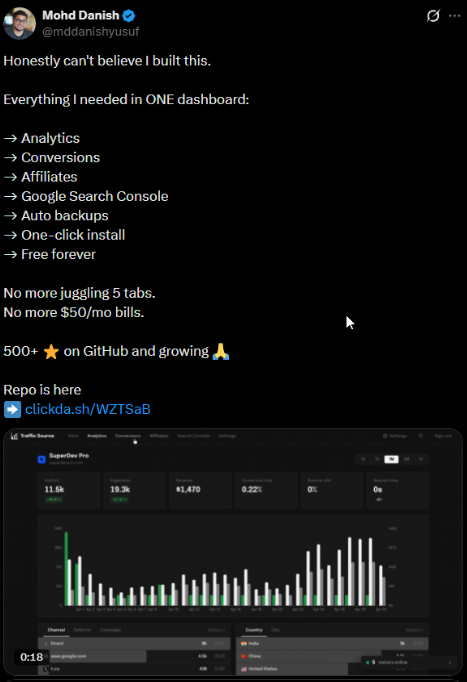
One of the biggest trends in the SaaS industry right now is “building in public.”
Developers and startup founders are actively sharing their product journey on platforms like Twitter (X) to attract users, gain feedback, and build an audience before the product even fully launches.
The example above from Mohd Danish is a perfect example of this strategy. Instead of simply talking about ideas, he showcases a real product solving real problems through a clean all-in-one dashboard that combines analytics, conversions, affiliates, Google Search Console integration, backups, and more.
This kind of public product showcasing not only builds credibility but also helps SaaS founders grow organically, gain early supporters, and create trust around their brand in 2026.
Source: https://x.com/mddanishyusuf/status/2049872833732387221?s=20
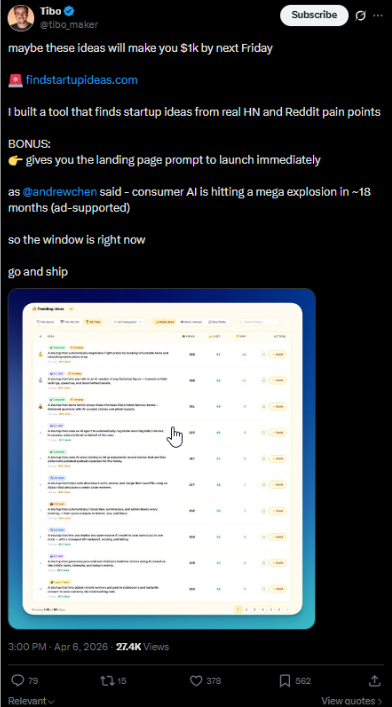
Another great example of modern SaaS marketing is how founders are turning simple problem-solving tools into viral products by sharing them publicly on Twitter (X). In the example above, Tibo showcases a SaaS tool that discovers startup ideas from real discussions happening on platforms like Reddit and Hacker News.
Instead of spending months guessing what users want, the product helps founders identify real pain points and even provides landing page prompts to launch faster.
This strategy works because people love products built around real market demand. By sharing progress, insights, and screenshots publicly, SaaS founders can attract attention, validate ideas quickly, and build an audience long before scaling the product.
Source: https://x.com/tibo_maker/status/2041086061753880973?s=20
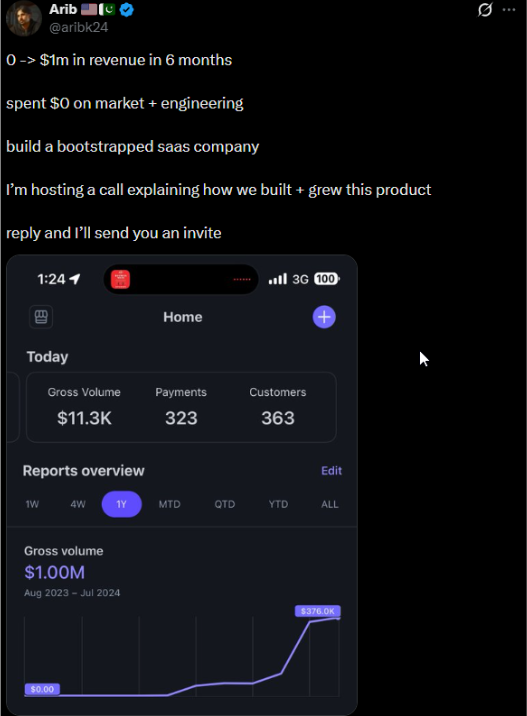
Another reason why many people are entering the SaaS industry in 2026 is because of how fast bootstrapped products can grow when solving the right problem.
In the example above, Arib shares how his SaaS product reportedly grew from $0 to $1 million in revenue within just 6 months without spending money on marketing or a large engineering team.
This highlights one of the biggest advantages of SaaS businesses today small teams can build scalable products and reach global customers through the internet.
Founders are now using platforms like Twitter (X) to publicly share revenue milestones, product updates, growth strategies, and lessons from building their startups.
This “build in public” approach helps SaaS founders gain trust, attract users, and create strong communities around their products organically.
It also proves that with the right idea, execution, and consistency, modern SaaS startups can scale much faster than traditional businesses.
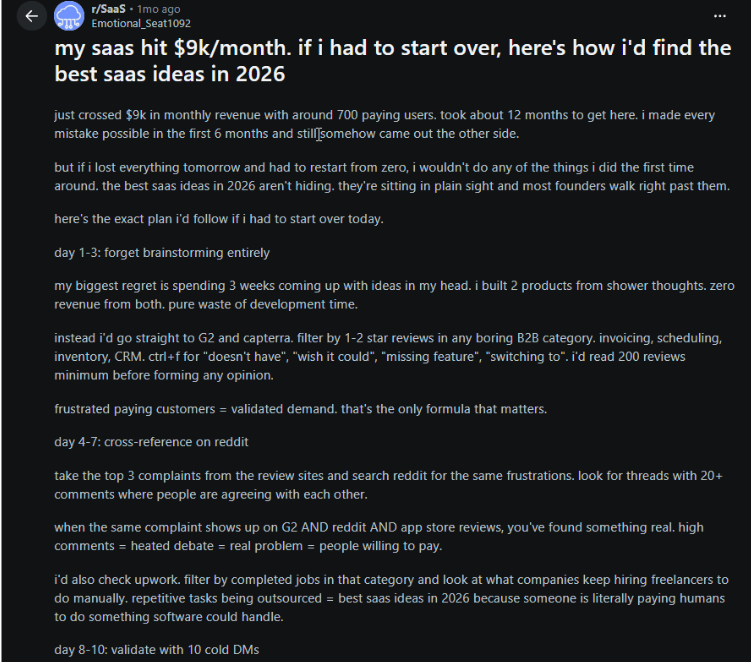
One of the smartest ways to find SaaS ideas today is by studying real user frustrations instead of randomly brainstorming ideas.
In the Reddit example above, a SaaS founder shares how his product reached $9,000/month in recurring revenue by focusing on real customer pain points rather than assumptions.
He explains that many successful SaaS ideas are already visible in places like G2, Capterra, Reddit, app reviews, and freelance marketplaces founders simply need to pay attention to repeated complaints and missing features.
This approach is becoming increasingly popular in 2026 because it reduces the risk of building products nobody wants.
Instead of spending months creating random ideas, successful SaaS founders now validate demand first by researching customer frustrations, industry gaps, and repetitive manual tasks businesses are already paying for.
The biggest lesson here is simple: the best SaaS products are often built by solving existing problems better, faster, or more affordably than current solutions.
How to Choose the Right SaaS Product Development Company
This is where a lot of founders make expensive mistakes.
Not because they’re careless.
Mostly because they don’t know what to look for yet.
On paper, almost every agency says the same things:
- “We build scalable SaaS products”
- “Expert development team”
- “Agile process”
- “End-to-end solutions”
But once development starts, the difference between a real SaaS-focused team and a generic development agency becomes painfully obvious.
A bad hiring decision usually doesn’t fail immediately.
It fails slowly.
Deadlines start slipping.
Communication gets messy.
Features become harder to build.
The product starts feeling unstable.
Simple updates suddenly take weeks.
And founders end up rebuilding parts of the product much earlier than expected.
That’s why choosing the right SaaS product development company is less about flashy portfolios and more about how the team thinks.
Here’s what founders should actually pay attention to.
Look for SaaS Experience Not Just Development Experience
This is probably the biggest mistake founders make.
A company can be great at building websites and still be terrible at SaaS product development.
SaaS products have completely different challenges:
- recurring billing
- onboarding
- permissions
- scalability
- retention
- APIs
- analytics
- infrastructure
- product iteration
Ask them specific SaaS questions.
For example:
- Have you built multi-tenant SaaS systems before?
- How do you usually structure MVP development?
- How do you handle scalability planning?
- What happens when user traffic grows quickly?
- How do you approach feature prioritization for startups?
You’ll learn very quickly whether they actually understand SaaS businesses or just sell development services.
Don’t Hire Based on Cheap Pricing
Cheap SaaS development usually becomes expensive later.
A lot of founders learn this the hard way.
Low-cost teams often:
- move fast without structure
- skip architecture planning
- create technical debt
- write messy code
- avoid documentation
- struggle with scalability
At first, everything looks fine.
Then six months later:
- features become harder to add
- performance drops
- bugs increase
- onboarding becomes painful
- developers start blaming old code
Now the founder has two problems instead of one:
building the product and fixing the product.
That doesn’t mean founders should overspend either.
The goal is finding a startup SaaS development company that understands lean execution without sacrificing long-term stability.
Pay Attention to How They Talk About MVPs
This tells you a lot.
A smart SaaS product development company will almost always push founders toward smaller MVPs first.
That’s usually a good sign.
If an agency immediately recommends building:
- complex dashboards
- advanced AI systems
- huge admin panels
- dozens of integrations
- enterprise features
before validation happens, that’s a red flag.
Good SaaS teams understand that startups need:
- speed
- validation
- early feedback
- iteration
Not giant feature lists.
The best development partners help founders launch quickly without overbuilding.
Communication Matters More Than Founders Expect
A lot of SaaS projects fail because communication breaks down.
Not because the developers were untalented.
Founders should ask:
- How often will updates happen?
- Who manages the project?
- What tools do you use for communication?
- How are delays handled?
- What happens if priorities change?
You want a team that communicates clearly especially when problems happen.
Because problems always happen in SaaS development.
Always.
A reliable SaaS development agency won’t disappear when things get complicated.
They’ll explain tradeoffs honestly and help solve issues quickly.
Look at Product Thinking, Not Just Design
Some agencies build visually impressive products that are terrible to use.
Founders should care less about flashy animations and more about:
- onboarding flow
- user simplicity
- dashboard clarity
- speed
- retention-focused UX
Good SaaS UX feels invisible.
Users shouldn’t need tutorials to understand basic workflows.
That’s why product thinking matters so much in SaaS software development.
Ask About Scalability Early
A lot of founders ignore scalability because they assume growth is a future problem.
But bad architecture decisions early can create massive issues later.
You don’t need enterprise-level infrastructure on day one.
But your development team should still think ahead.
Ask questions like:
- Can this architecture scale later?
- How will database performance be handled?
- How easy will future integrations be?
- What happens if user activity spikes?
- How modular is the codebase?
Experienced SaaS teams think about future growth without overengineering the MVP.
That balance matters.
Check How They Handle Post-Launch Support
Launch day is not the finish line.
It’s the beginning.
After launch, founders usually need:
- bug fixes
- feature updates
- optimization
- infrastructure scaling
- analytics improvements
- AI integrations
- onboarding improvements
A strong SaaS product development company stays involved after release.
Because real SaaS growth happens through iteration.
Not through one perfect launch.
Choose a Team That Understands Startups
This matters more than founders think.
Enterprise-focused agencies and startup-focused agencies operate very differently.
Startups need:
- fast execution
- lean MVPs
- flexibility
- rapid iteration
- honest prioritization
- practical decision-making
Not endless meetings and bloated planning cycles.
The best startup SaaS development companies understand founder pressure.
They know budgets matter.
They know timelines matter.
And they know early traction matters more than perfection.
That mindset changes how products get built.
The Best SaaS Development Partners Feel Like Product Partners
That’s probably the simplest way to explain it.
A good development company builds what you ask for.
A great SaaS product development company helps you figure out what actually needs to be built.
There’s a huge difference between those two things.
And founders usually feel that difference very early in the process.
Top 5 SaaS Product Development Companies in 2026
1. Growable Digital
Growable Digital has been gaining attention as a startup-focused SaaS product development company that works closely with founders building scalable SaaS products and MVPs.
What makes them stand out is their product-first approach.
Instead of pushing founders toward massive development cycles, the team focuses heavily on:
- lean MVP development
- scalable architecture
- AI-ready SaaS products
- fast execution
- transparent communication
They’re especially well-suited for:
- startup founders
- early-stage SaaS businesses
- AI SaaS products
- founders validating new product ideas
One thing founders often appreciate is that the team communicates in a practical, business-focused way instead of overwhelming non-technical founders with unnecessary technical complexity.
That becomes extremely valuable during early product decisions.
Why Many Startups Choose Growable Digital for SaaS Development
Building a startup product is stressful.
Founders are balancing:
- validation
- timelines
- budgets
- investors
- product decisions
- growth pressure
That’s why choosing the right technical partner matters so much.
Growable Digital works with startups differently than traditional development agencies.
Instead of overengineering products early, the focus stays on:
- lean MVP execution
- scalable architecture
- AI-ready systems
- startup-focused product strategy
- rapid iteration
- long-term scalability
Whether founders are building:
- SaaS platforms
- AI products
- marketplaces
- automation tools
- custom software
- startup web applications
Growable Digital helps startups move from idea to scalable product without unnecessary complexity.
The goal is not just launching software.
It’s building products users actually want.
If you want a deeper breakdown of MVP strategy, costs, timelines, SaaS development, startup scaling, and custom software planning, check out Growable Digital’s complete guide on:
Book a Free Audit Call with Us
2. Blackthorn Vision
Blackthorn Vision is an Android app development company focused on building reliable, scalable, and performance-driven mobile applications for businesses across different industries. The company emphasizes clean architecture, efficient coding practices, and long-term maintainability, ensuring that apps remain stable as they grow. Their development approach is centered around understanding business requirements and translating them into functional, user-friendly Android applications. Blackthorn Vision also integrates modern technologies and follows structured development processes, including thorough testing and optimization, to deliver applications that perform consistently across devices.
3. WillowTree
WillowTree is an Android app development company known for delivering high-quality mobile applications with a strong focus on user experience, performance, and scalability. The company works with both startups and large enterprises, building Android apps that are designed to handle high user demand and complex functionality. Their approach combines strategy, design, and engineering to create applications that are intuitive, reliable, and aligned with business goals. WillowTree also emphasizes modern development practices, continuous testing, and post-launch support to ensure long-term success and consistent app performance.
4. Fueled
Fueled is an Android app development company recognized for building visually engaging, high-performance mobile applications with a strong emphasis on user experience and product strategy. The company focuses on creating apps that are not only functional but also designed to drive user engagement and business growth. Their team combines design, development, and strategic thinking to deliver Android applications that are scalable, intuitive, and aligned with modern market demands. Fueled also follows a structured development process with continuous testing and optimization to ensure smooth performance across devices and long-term reliability.
5. Bluelabellabs
Blue Label is an Android app development company that focuses on building scalable, user-centric mobile applications tailored to business goals. The company combines product strategy, design, and engineering to create Android apps that deliver strong performance and seamless user experiences. Their approach emphasizes collaboration, ensuring that each app aligns with the client’s vision while maintaining technical efficiency and reliability. Blue Label also follows structured development processes, including testing and iteration, to ensure applications are optimized for performance, usability, and long-term growth.
Frequently Asked Questions
1. What does a SaaS product development company do?
A SaaS product development company helps founders build cloud-based software products from idea to launch. This usually includes strategy, MVP development, UI/UX design, backend development, cloud setup, testing, scaling, and ongoing support.
2. How much does it cost to build a SaaS product in 2026?
The cost depends on product complexity, features, integrations, and team experience.
Typical ranges:
- Basic MVP SaaS product: $15,000–$40,000
- Mid-level SaaS platform: $40,000–$120,000
- Enterprise SaaS product: $150,000+
Most startups begin with a lean MVP before scaling further.
3. How long does SaaS product development take?
A simple MVP usually takes around 2–4 months.
More advanced SaaS platforms with custom workflows, AI integrations, and enterprise-level features can take 6–12 months or longer depending on scope.
4. Should startups build an MVP first?
Yes almost always.
Building an MVP helps founders validate demand before investing heavily in development. It also allows startups to collect real user feedback early instead of guessing what users want.
5. Why hire a SaaS development company instead of freelancers?
Freelancers can work well for small tasks, but SaaS products usually require:
- product strategy
- UI/UX design
- backend architecture
- DevOps
- QA testing
- scalability planning
A SaaS development company provides a full team and structured development process, which reduces long-term risk.
6. What is the best tech stack for SaaS development in 2026?
A common modern SaaS stack includes:
- React or Next.js for frontend
- Node.js or Python for backend
- PostgreSQL for database
- AWS for cloud infrastructure
- AI APIs for automation and AI features
The ideal stack depends on the product’s goals and scalability needs.
7. Can non-technical founders build SaaS products?
Absolutely.
Many successful SaaS founders are non-technical. The key is partnering with the right SaaS product development company that can guide technical decisions while the founder focuses on business growth and customer problems.
8. Why do startups outsource SaaS development to India?
India has become a major SaaS development hub because of:
- strong technical talent
- cost-efficient development
- fast execution
- startup-friendly teams
- global SaaS experience
Many startups choose India-based SaaS development agencies to reduce costs without sacrificing quality.
9. What are the biggest mistakes founders make during SaaS development?
Some of the most common mistakes include:
- building too many features too early
- skipping market validation
- hiring cheap developers
- ignoring scalability
- launching without proper testing
Most SaaS problems start with poor early decisions.
10. Which company is best for SaaS product development in India?
The right company depends on your product goals, budget, and stage.
Many founders look for teams that specialize in:
- MVP SaaS development
- scalable architecture
- AI-ready products
- startup-focused execution
- transparent communication
Growable Digital is one of the companies startups consider for SaaS product development because of its lean MVP-first approach and focus on scalable SaaS systems.
Warning: Trying to access array offset on false in /home/u971387193/domains/growabledigital.com/public_html/wp-content/themes/safebyte/inc/classes/class-blog.php on line 242